
Androgen Insensitivity Syndrome (AIS Horse)
→ Infertility and external female genitalia in male horses.
Symptoms
- Affected horses (genotypic males) have external female genitalia.
- Underdeveloped uterus and underdeveloped, retained testes
- Infertility
- Typical male-like behavior
General Information
- Affected foals appear like normal females.
- Underdeveloped male and female genitalia result in infertility.
- Retained testes are usually surgically removed.
- A malfunction of androgen receptor (male steroid hormone) causes the syndrome.
- No other effects on health of affected horses are known.
Breeds affected
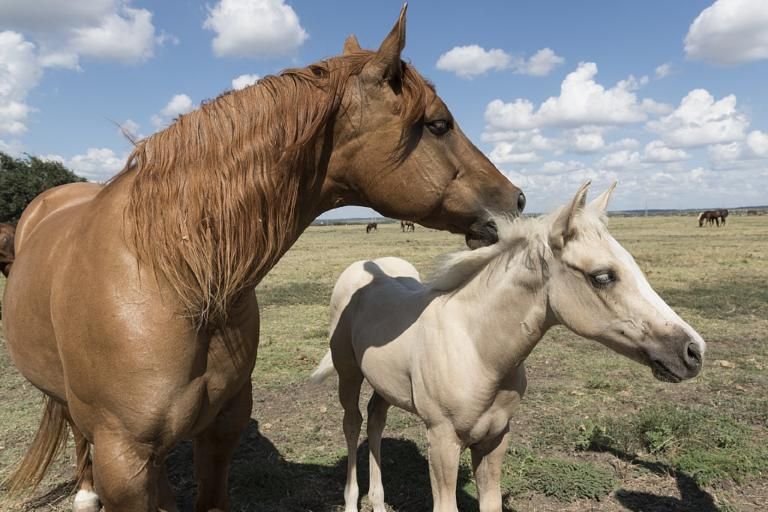
Quarter Horse and related breeds
Test information
This test detects the single basepair change in the ARgene.
Genotype and Lab Report
Inheritance: X-chromosomal recessive
→ The affected gene is located on the X-chromosome. Females have two versions of this chromosome while males only have one. Males with this variant are affected by AIS. Females can be carriers of this variant (heterozygous, X/X-ais).
Genotype:
X/X = normal female
The mare has no genetic variant causative for the AIS and therefore cannot pass it on to its offspring.
X/X-ais = carrier female
The mare is clinically healthy. The genetic variant will be passed on to its offspring with a probability of 50%. If the variant is passed on to male offspring, the foal will be an affected male.
X/Y = normal male
The male has no genetic variant causative for the AIS.
X-ais/Y = affected male
The male appears to be a normal female but has the male genotype (XY) and is infertile.
Recommendations
- Offspring of a carrier female should be tested for their genotype (X/X or X/X-ais or X-ais/Y → affected male).
- Carrier females (X/X-ais) may be used for breeding but their male offspring have a 50% of being affected.
- Affected males (X-ais/Y) are infertile but otherwise healthy.
Literature
Révay, T., Villagómez, D.A., Brewer, D., Chenier, T., King, W.A.: GTG mutation in the start codon of the androgen receptor gene in a family of horses with 64,XY disorder of sex development. Sex Dev 6:108-16, 2012. Pubmed reference: 22095250. DOI: 10.1159/000334049.
Further information is available at Online Mendelian Inheritance in Animals.