
Agouti | Bay/Black (Base colour A-Locus Horse)
Three base colours occur in the horse: Chestnut (reddish), Black and Bay (Brown). The base colour is determined by the combination of the Agouti Locus (A) and Extension Locus (E).
The Agouti gene (A) controls the ratio of black to red pigment in melanocytes (pigment-producing cells), changing the distribution of black pigment over the body.
One functional gene (AA or Aa) results in the brown base colour (bay), in which the black pigment is concentrated on the legs, mane, and tail. Two non-functional copies (aa) lead to the exclusive production of the black pigment and thus to a black base colour. The base colour "chestnut" (extension locus "ee") is not influenced by the Agouti gene.
Genetic Test:available in Shop
Also in the Base Colour package
General Information
- The Agouti gene (A) is involved with the production of both red (pheomelanin) and black (eumelanin) pigments.
- It regulates the relative amounts of each pigment produced in melanocytes (pigment-producing cells) in different regions of the horse's body.
- A functional version (AA or Aa) results in a horse that has a base colour of bay with black points (mane, tail, legs, ear tips). Red and black pigments are both produced and deposited into hairs on the body, and only black pigment is produced in the points.
- Two non-functional copies (aa) result in a horse with a black base colour, because dark pigment is produced over the entire body.
- The base colour chestnut (Extension locus "ee") is not influenced by the Agouti gene.
Test Information
Locus Information:A Locus
This test detects an 11 basepair deletion (g.2174_2184del11) in the ASIPgene.
Test inShop
Genotype and Lab Report
Inheritance: autosomal recessive
→ Horses with two or one copies of the functional Agouti variant (AA, Aa) will be bay in colour. Only horses with two non-functional copies of the Agouti variant (aa) will be black.
Genotype
A/A = Two functional copies
The horse is bay, black pigments are restricted to legs, head, mane and tail.
A/a = One functional and one non-functional copy
The horse is bay but carries the factor for black.
a/a = Two non-functional copies
The horse is black. No red pigment is produced, only black pigment.
Appearance
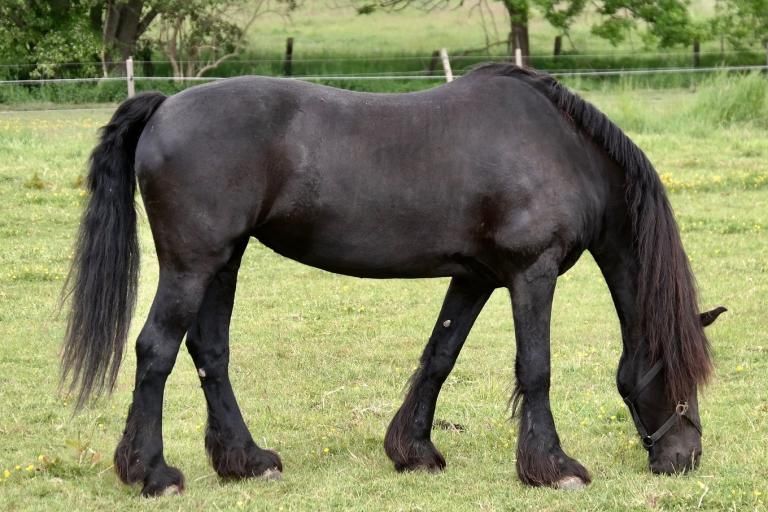
Black
Black base colour over the entire body.
Possible genotypes:
- EEaa = Homozygous recessive Agouti
- Eeaa = Homozygous recessive Agouti (Carries Chestnut at Extension locus)
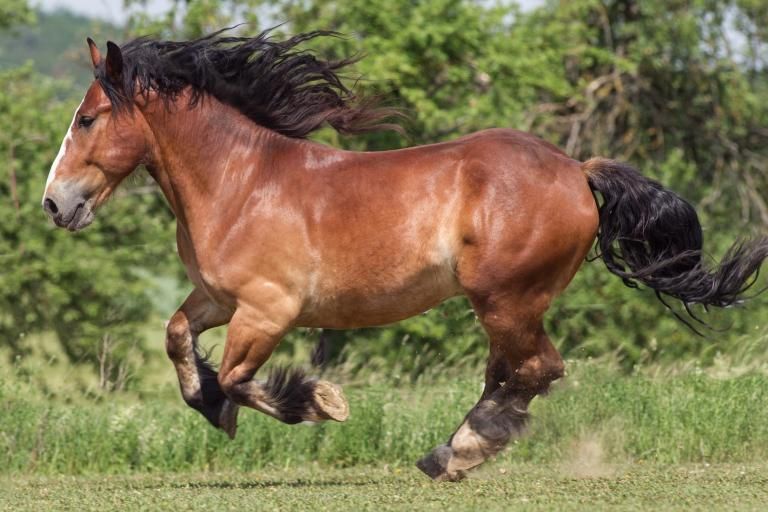
Bay
Brown base colour over the body with black mane, tail, and legs.
Possible genotypes:
- EEAA = Homozygous dominant Agouti
- EeAA = Homozygous dominant Agouti (Carries Chestnut at Extension locus)
- EeAa = Heterozygous at Agouti (Carries Black, carries Chestnut at Extension locus)
- EEAa = Heterozygous at Agouti (Carries Black)
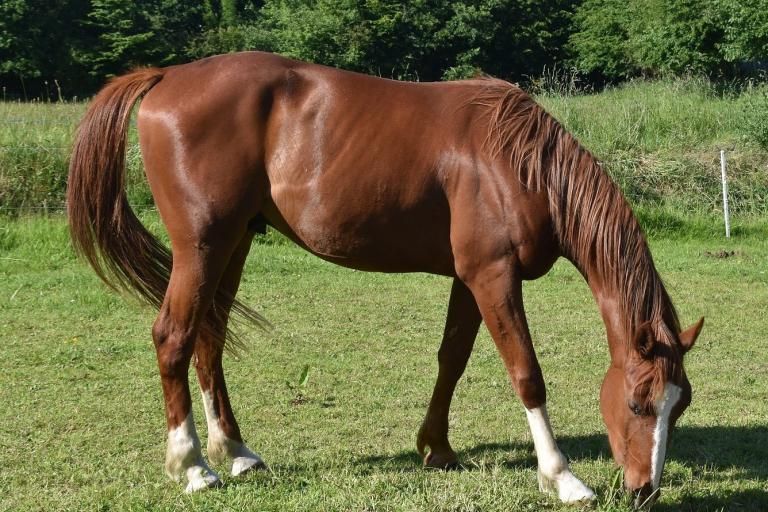
Chestnut
Sorrel to red base colour over the entire body, sometimes with lighter mane and tail.
Possible genotypes:
- eeAA = Homozygous for dominant Agouti
- eeAa = Heterozygous at Agouti (Carries Black)
- eeaa = Homozygous for recessive Agouti (Carries Black)
Literature
Rieder, S., Taourit, S., Mariat, D., Langlois, B., Guerin, G.: Mutations in the agouti (ASIP), the extension (MC1R), and the brown (TYRP1) loci and their association to coat color phenotypes in horses (Equus caballus). Mammalian Genome 12:450-455, 2001. Doi: 10.1007/s003350020017.
Further information is available at Online Mendelian Inheritance in Animals.