
Ichthyosis (PNPLA1-related Golden Retriever)
Ichthyosis (PNPLA1-related) is a cornification disorder of the skin. This leads to defects in the development of the outer layer of the epidermis. Affected animals show increased scaling (desquamation) and detachment of the outer skin layer.
The hereditary disease occurs in the Golden Retriever. The inheritance is autosomal recessive.
Synonym: ICT-A
Genetic Test: The test is patented and is currently not offered by Generatio.
Symptoms
- Dry skin
- Increased scaling (larger, darker)
- Keratinized skin patches
General Information
- Ichthyosis (PNPLA1-related) is a cornification disorder of the skin.
- This involves defects in the development of the outer layer of the epidermis.
- First symptoms appear at the age of 3-6 weeks, but are often only noticed later when they become more severe.
- In the Golden Retriever, this disease is caused by a mutation in the PNPLA1 gene; in other breeds, other genes are affected.
Breeds affected
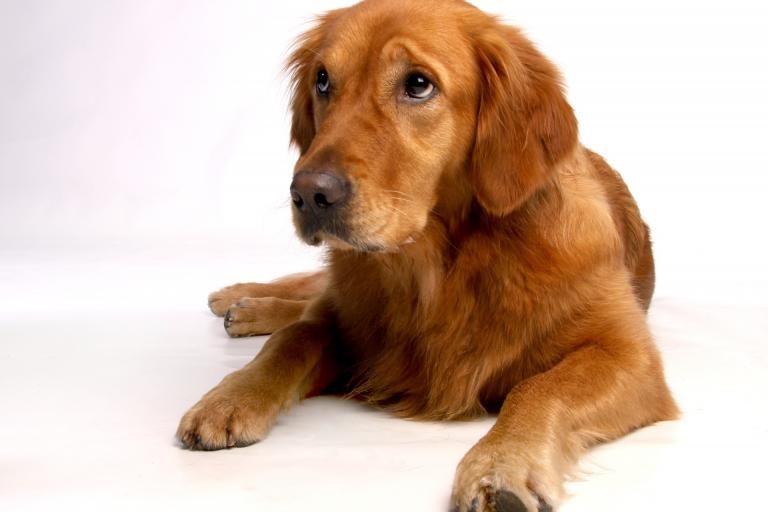
Golden Retriever
Test Information
This mutation test detects an insertion deletion (c.1445_1447delinsTACTACTA) of the PNPLA1 gene.
The test is patented and is currently not offered by Generatio.
Genotype and Lab Report
Inheritance: autosomal recessive.
→ The hereditary disease only occurs if both alleles of the gene are affected by the mutation (ich/ich). Dogs that have only one allele with the causative mutation (N/ich) are clinically healthy carriers.
Genotypes:
N/N = genetically normal
The dog has no predisposition for Ichthyosis and therefore cannot pass it on to its offspring.
N/ich = a carrier
The dog is a clinically healthy carrier. The variation is passed on 50% to the offspring, which are also carriers.
ich/ich = affected
The variation is passed on 100% to the offspring. The offspring are carriers or affected.
Recommendations
- Carrier animals can be bred to normal animals (N/ich x N/N). Before using the offspring in breeding, it should be tested whether they are normal or carriers.
- Mating two carrier animals (N/ich x N/ich) should be avoided because there is a 25% chance that the offspring will be affected.
- Affected animals (ich/ich) should be excluded from breeding.
Literature
Grall, A., Guaguère, E., Planchais, S., Grond, S., Bourrat, E., Hausser, I., Hitte, C., Le Gallo, M., Derbois, C., Kim, G.J., Lagoutte, L., Degorce-Rubiales, F., Radner, F.P., Thomas, A., Küry, S., Bensignor, E., Fontaine, J., Pin, D., Zimmermann, R., Zechner, R., Lathrop, M., Galibert, F., André, C., Fischer, J.: PNPLA1 mutations cause autosomal recessive congenital ichthyosis in golden retriever dogs and humans.Nat Genet 44:140-7, 2012. Pubmed reference: 22246504. DOI: 10.1038/ng.1056.
Further information is available at: Online Mendelian Inheritance in Animals.