
Dystrophic Epidermolysis Bullosa (DEB Dog)
Dystrophic epidermolysis bullosa (DEB) is a skin disease in which skin lesions and blistering occur because the individual skin layers are not properly connected. Affected animals show reduced skin growth and scarring, which also affects the internal mucous membranes and can therefore lead to problems in the digestive tract.
The disease occurs in the Golden Retriever. The inheritance is autosomal recessive.
Symptoms
- Skin lesions and blistering after irritation, but also spontaneously
- Healing frequently with scar formation, increasing scarring of the skin
- Problems in the digestive tract, as the internal mucous membranes are affected as well
General Information
- Dystrophic epidermolysis bullosa (DEB) is a skin disease caused by a lack of connection between the individual skin layers.
- A mutation leads to the malformation of a type of collagen which is an important factor for anchoring the individual skin layers (basement membrane in the dermis).
- Affected animals have a severely reduced quality of life and, depending on the severity, have to be euthanised.
Breeds affected
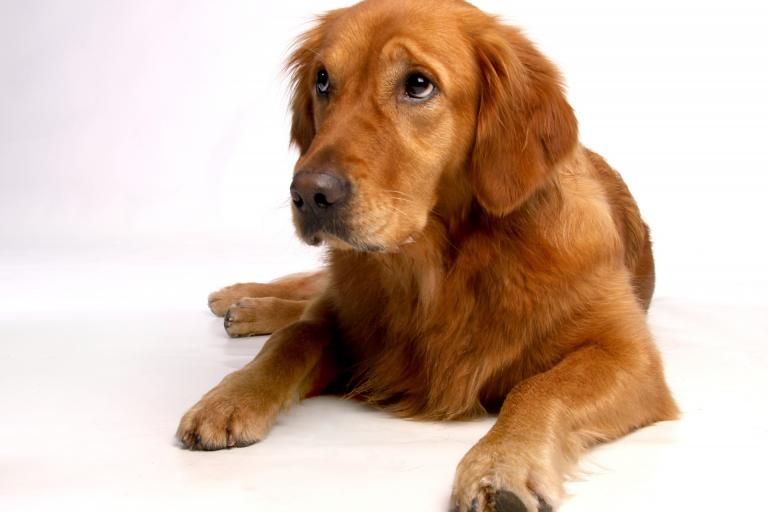
Golden Retriever
Test Information
This mutation test detects a change of a single base pair (c.5716G>A) in the COL7A1 gene.
Genotype and Lab Report
Inheritance: autosomal recessive
→ The disease only occurs if both alleles of the gene are affected by the mutation (deb/deb). Dogs that have only one allele with the causative mutation (N/deb) are clinically healthy carriers.
Genotypes:
N/N = genetically normal
The dog has no predisposition for DEB and therefore cannot pass it on to its offspring.
N/deb = a carrier
The dog is a clinically healthy carrier. The variation is passed on 50% to the offspring, which are also carriers.
deb/deb = affected
The variation would be passed on 100% to the offspring. The animals do not reach breeding age.
Recommendations
- Carrier animals can be bred to normal animals (N/deb x N/N). Before using the offspring in breeding, it should be tested whether they are normal or carriers.
- Mating two carrier animals (N/deb x N/deb) should be avoided because there is a 25% chance that the offspring will be affected.
- Affected animals (deb/deb) should be excluded from breeding.
Literature
Baldeschi, C., Gache, Y., Rattenholl, A., Bouillé, P., Danos, O., Ortonne, J.P., Bruckner-Tuderman, L., Meneguzzi, G.: Genetic correction of canine dystrophic epidermolysis bullosa mediated by retroviral vectors.Hum Mol Genet 12:1897-905, 2003. Pubmed reference: 12874109
Palazzi, X., Marchal, T., Chabanne, L., Spadafora, A., Magnol, J.P., Meneguzzi, G.: Inherited dystrophic epidermolysis bullosa in inbred dogs: A spontaneous animal model for somatic gene therapyJournal of Investigative Dermatology 115:135-137, 2000. Pubmed reference: 10886525. DOI: 10.1046/j.1523-1747.2000.00031-5.x
Further information is available at Online Mendelian Inheritance in Animals.